Archive
Thoughts
-
The State of Physical Retail in the US (2022–2025): Big-Box and Grocery Chains
Despite the rise of e-commerce, physical retail in the U.S. is proving far more resilient than many expected — especially in the big-box and grocery sectors. Over the past three years, retailers like Walmart, Target, Costco, and Aldi have not only maintained but strategically expanded their physical footprints. While 2022 and 2023 saw more store…

-
Common Issues with Retail FF&E and How to Mitigate Them – Part One
Building out physical retail stores is a high-stakes game—one where a single misstep can cost thousands (or even millions). Have you ever had a store opening delayed because the wrong fixtures arrived? Or watched in horror as a brand-new display case was installed upside down? You’re not alone. Mistakes in procurement, installation, and project management…

-
McDonaldization and Construction: How Owner-Furnished Items Unlock Scalability
McDonaldization describes how industries optimize for efficiency, predictability, uniformity, and control. This principle doesn’t just apply to burgers, it’s the secret sauce behind how companies like Walmart, Dollar General, and Wegmans scale their physical stores to thousands of locations worldwide.

-
Decluttering Your Data: Why AI Alone Won’t Solve the Mess
Imagine your home is overflowing with clutter. You hire a professional organizer who tidies everything up—but without proper shelves and storage, the clean items just end up in a neat pile on the floor. That’s what happens when you rely solely on AI to clean up your asset data, especially when managing furniture, fixtures, and…

-
Lean Out Your BIM Processes by Reducing Asset Information in Your Models
Let me tell you a little secret about working in BIM: the more data you cram into your model, the more of a nightmare it becomes to manage. Early in my career as a BIM Manager, I thought it was smart to add as much data as possible to Revit Families for owner-furnished items (OFI).

-
Manual data entry is so 2024.
It’s 2025 and we’re still doing manual data entry? Check out this video demo of how Kit, our AI copilot in Ephany, is now able to solve this problem.

-
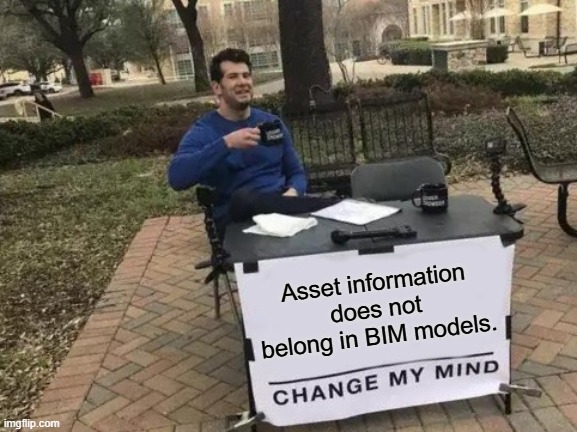
Asset information does not belong in BIM. Change my mind.
I believe BIM is experiencing some growing pains, as with any new technology would. I’m starting to see that there is too much data in models, particularly regarding assets such as the furniture, fixtures, and equipment (FF&E). I do agree that any data that is required for design and construction processes need to be included…
-
Asset Identification is Key to Success in Repeatable Design and Construction
Imagine navigating a world where identification numbers didn’t exist. Without bank account numbers, driver’s license numbers, and social security numbers, it would be nearly impossible to look up information about a specific person with 100% certainty that you’re not mixing up people with the same name. Shouldn’t every piece of furniture, fixture, and equipment (FF&E)…
-
Managing FF&E asset data for repeatable designs sounds easy, but it’s not.
Managing furniture, fixtures, and equipment (FF&E) across a fleet of stores is a complex challenge for physical retail organizations. Surprisingly, some of the largest retail brands in the world are managing those assets in Excel spreadsheets (or other similar format). If that statement resonated with you, the below image probably looks all too familiar.

-
Revit + Smartsheet: Mapping Asset Data from BIM to an External Data Source
In the world of PropTech, I’ve run into the same challenges many teams face. Recently, Triple Zero Labs partnered with a major owner/operation to rethink how they manage procurement and forecasting for their assets — and the results have been game-changing. The Problem We quickly uncovered three big blockers: 1. Manual data entry slows everything…