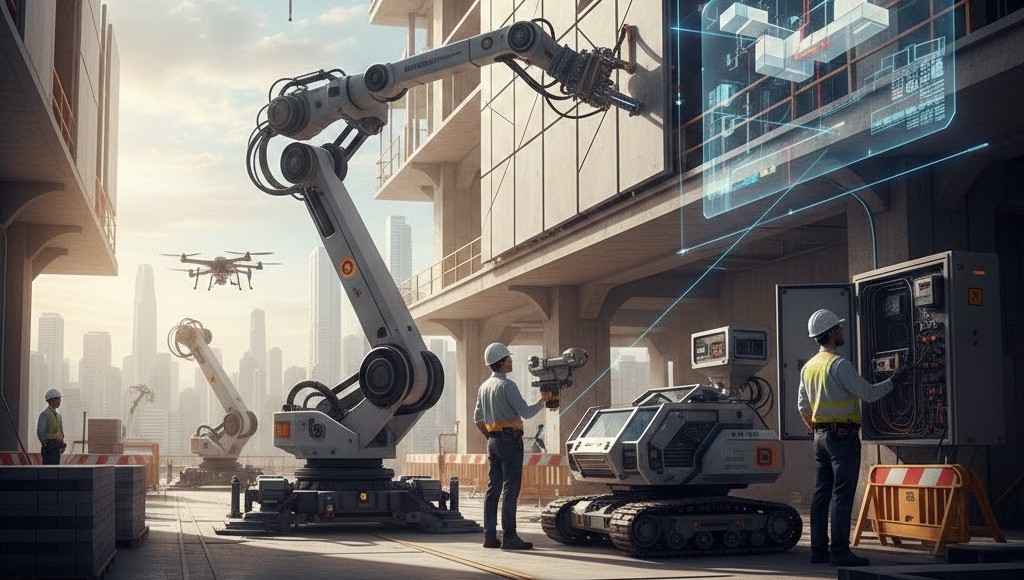
We Want Digital Perfection, but We’re Building with Analog Hands
Let’s face it, we’re living in the future, right? We have self-driving cars (sort of), phones that can practically read our minds, and we’re sending rockets to Mars for fun. So why, oh why, are we still building things with paper plans and tape measures? Everyone in architecture, engineering, and construction (AEC) is buzzing about Building Information Modeling (BIM) and 3D models. The dream is to go straight from a meticulously designed 3D model to physical construction, seamlessly. And I’m here to tell you, as someone who has lived in the construction trenches (more like in the site trailer building models), that it’s a pipe dream without a robotic revolution.
Now, before you grab your torches and pitchforks, hear me out. I’m not saying I want to replace humans. I love humans! Some of my best friends are humans. But the reality of what we’re asking our incredibly skilled human workforce to do when we talk about model-based construction is, frankly, a bit nuts.
Imagine a beautiful 3D model, perfectly accurate to the millimeter. Now imagine a human, squinting at a tablet on a dusty job site, trying to translate that digital perfection into physical reality with a hammer and nails. It’s like asking a concert pianist to play a symphony after only being shown a picture of the sheet music. There’s a fundamental disconnect.
We talk about the precision of 3D models, and rightly so. They represent an incredibly detailed vision. But then we hand that vision off to a process that’s inherently analog and prone to human error. According to a study by PlanGrid, rework costs the global construction industry an estimated $280 billion annually, with a significant portion attributed to errors and omissions. Many of those errors stem from the interpretation and translation of design intent on a chaotic job site.
Here’s where my “unpopular opinion” really kicks in. We’re asking our human workforce to achieve robotic levels of precision and consistency, and that’s just not fair. Humans get tired. Humans get distracted. Humans have good days and bad days. Robots? Not so much. Robots thrive on repeatable tasks, precise measurements, and relentless execution: structured data. They don’t get hungry, they don’t react to the weather, and they certainly don’t misplace the laser level.
Think about it: laying out a complex facade with varying angles and dimensions, ensuring every anchor point is exactly where it needs to be. Or installing intricate MEP systems where clashes are identified in the model, but preventing them in the field requires superhuman spatial awareness and meticulous execution. We’re asking for perfection from an imperfect process.
“But what about skilled tradespeople?”
“Are you saying they’re not good enough?”
Absolutely not! Our tradespeople are incredibly talented and essential. But imagine if they were empowered by robotic assistance, allowing them to focus on the truly complex problem-solving and craftsmanship, rather than the monotonous, repetitive tasks that a robot could handle with far greater accuracy and speed.
We’re already seeing glimpses of this future. Robotic total stations are becoming more common for layout, and companies are experimenting with robotic bricklaying and even autonomous heavy equipment. And of course we can’t forget about one of the first construction robots I had ever seen: Spot by Boston Dynamics.
This isn’t about replacing humans wholesale; it’s about optimizing the entire construction process. It’s about taking the incredible potential of 3D modeling and finally unlocking it in the physical world. It’s about reducing that $280 billion in rework and delivering projects faster, safer, and with unprecedented quality.
So, while it might be an unpopular opinion now, I firmly believe that the true promise of model-based construction, that seamless leap from digital design to physical reality, will only be fully realized when robots are doing the precise measuring and installation; essentially what the manufacturing sector has been doing for decades. And when that day comes, our human workforce can focus on what they do best: innovating, problem-solving, and bringing their unique human creativity to the art of building. And maybe, just maybe, they’ll even get to take a break without worrying if that wall is plumb.
