
If you’re used to building apps by prompting, you’ve probably heard of the Model Context Protocol (MCP). It’s the magic bridge that lets your AI assistant actually do things like read your local files, browse a database, or trigger actions. It feels like an absolute superpower for open-ended tasks. But as more of us use AI to build software, an expensive trap is appearing: we’re starting to use an AI brain to do a robot’s job.
Let’s say you need to sync data between two platforms. Your first instinct as an advanced LLM user might be to spin up an MCP server, point an AI agent at it, and say, “Migrate these records.” But using a wildly intelligent, unpredictable AI to handle a rigid, boring data transfer is overkill. It eats up tokens, slows down your app, and introduces the risk of the AI creatively hallucinating a wrong database entry.
Sometimes, you don’t need an autonomous agent; you just need a reliable pipeline.
Here is how to know when your next backend task needs the exciting magic of MCP, and when you should just use a traditional, old-school API script to move your data safely.
The Fundamental Divergence: Agentic vs. Deterministic
To choose the right tool, you have to look at the consumer of the data.
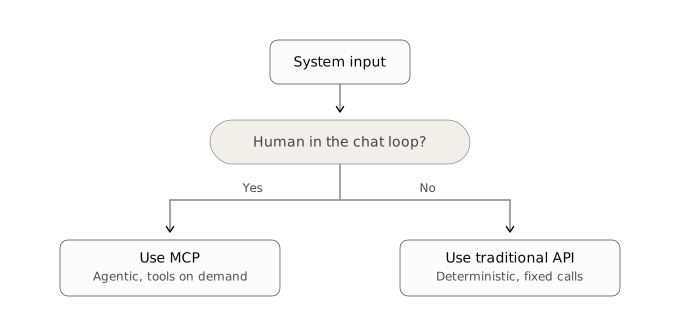
1. The MCP Model (Agentic Execution)
MCP is built for LLMs and AI agents. It creates a standardized, universal wrapper around APIs so an AI can dynamically inspect a tool kit, reason through a user’s prompt, and choose which API endpoint to hit.
- The Magic: It excels at unpredictable, fluid workflows. If a human says, “Look through my CRM, find accounts that haven’t been touched in 30 days, draft a personalized email, and log it in Slack,” MCP is perfect. The AI navigates the ambiguity.
- The Catch: It requires an LLM to be in the execution loop. Every single time data moves, it has to pass through an AI model that interprets the instruction and decides what to do next.
2. The Traditional API Model (Deterministic Pipelines)
Traditional integrations are written by human developers using hardcoded logic. You map Endpoint A directly to Endpoint B.
- The Magic: It is entirely deterministic. If you run the code 1,000 times, it will behave exactly the same way 1,000 times. There is no guesswork, no “interpretation,” and no margin for error.
- The Catch: It is rigid. If the source API changes its schema without warning, the pipeline breaks until a developer updates the code.
Side-by-Side: The Invisible Trade-Offs
| Decision Vector | Traditional API Pipeline | MCP Server + LLM Agent |
|---|---|---|
| Execution Latency | Sub-second (50ms–300ms); direct network request to DB or service. | Multi-second (2s–8s+); bottlenecked by LLM reasoning loops. |
| Operational Cost | Flat, negligible compute cost ($0 to pennies) | Recurring variable Token Spend (scales with data volume) |
| Behavior | 100% Predictable (Deterministic) | Variable (Non-deterministic; LLMs can hallucinate or fail to trigger) |
| Payload Efficiency | Direct JSON transmission | Data must be wrapped in AI context templates |
| Best Suited For | Scheduled, automated background syncs | Interactive, chat-based workflows |
The Hidden Costs of Hype: Token Spend and Hallucinations
When a project doesn’t require a human UI or conversational flexibility—for example, if it’s a silent background task that extracts data from Web App A and drops it into Web App B on the 1st of every month—introducing an MCP layer introduces two severe liabilities:
1. The Token Tax
Traditional API pipelines cost almost nothing to run. A script wakes up on a serverless function (like AWS Lambda), passes data directly from one endpoint to another, and shuts down. Your monthly infrastructure cost is a fraction of a dollar.
If you route that same data transfer through an LLM via an MCP server, you are paying for the LLM to read the data, “think” about where it goes, and generate the function call. If you are processing thousands of data rows or heavy JSON payloads, your token bill will skyrocket exponentially for a task that a simple script could do for free.
2. The Risk of Non-Determinism
LLMs are probabilistic. They guess the next best word or action. While they are remarkably accurate, they are never 100% consistent. On month three, the LLM might misinterpret a data field, hallucinate a missing value, or simply fail to invoke the tool due to a subtle context window shift.
For data ingestion feeding downstream analytics, even a 1% failure rate ruins the integrity of your entire dataset.
The Final Verdict: How to Choose
Before writing a single line of code, ask your team this one defining question:
“Does a machine need to figure out how to do this on the fly, or do we already know exactly what needs to be done?”
If your system needs to run silently in the background, on a fixed schedule, with zero human intervention, and with a predefined dataset, skip the AI wrapper. Write a clean, robust, deterministic API script. Keep your data predictable, eliminate token overhead, and let your downstream analytics apps do what they do best on clean, reliable data.
Save MCP for your front-facing AI tools where its dynamic reasoning can actually shine. Anything else is just paying a premium to let an AI do a machine’s job.
Leave a Reply